Mawa Modak Recipe: Richer Than Steamed, Ready in 20 Minutes
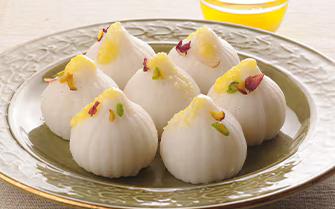
This easy mawa modak recipe uses khoya, sugar, and cardamom to make delicious festival-ready modak in under 20 minutes — no steaming required.
Prep time
10 minutes (+ 20–30 minutes cooling and setting time)
Cook time
10 minutes
Cuisine
Indian (Maharashtrian)
Ingredients
Nutrition
The mawa modak recipe is the Ganesh Chaturthi sweet that delivers the most richness for the least technical effort. No rice flour dough to manage, no pleating to practice, no steaming vessel to set up — just khoya cooked with powdered sugar and cardamom until it pulls away from the pan, cooled until handleable, then pressed into a mould or shaped by hand. This guide covers the traditional fresh khoya method, the milk powder shortcut for when khoya isn't available, the homemade khoya approach for anyone who wants the freshest possible result, and the shaping technique for both mould and no-mould scenarios. For the complete Ganesh Chaturthi festival sweet list including besan ladoo, coconut ladoo, and karanji, see the full Ganesh Chaturthi recipes guide.
Why Mawa Modak Is the Better Choice for First-Timers
The steamed ukadiche modak requires three separate technical skills — rice flour dough preparation, hand-pleating, and steaming timing — each of which can produce a failed batch independently. The mawa modak recipe for Ganesh Chaturthi needs none of those skills. The method is closer to making a barfi or peda than a steamed dumpling, which means anyone who has made Indian mithai before will find the entire process familiar, and even those who haven't will encounter fewer failure points. What mawa brings to the recipe is straightforward: concentrated milk solids produce a richness that rice flour alone can't match, and the natural sweetness of khoya means less added sugar is needed to produce a genuinely satisfying Ganesh Chaturthi sweet. These festive sweets work as both puja prasad and gifting items, since they hold their shape at room temperature for a day and refrigerate well for several more. For the steamed version that pairs with this on a traditional puja plate, the ukadiche modak recipe covers the rice flour version in full technique detail.
Ingredients for the Best Mawa Modak Recipe
A batch of 15–18 medium modak uses: 250g (about 1 cup) of khoya (mawa), 4–5 tablespoons (about 40–50g) of powdered sugar, ½ teaspoon cardamom powder, and 1 tablespoon of ghee for greasing the mould or palms. Optional additions: a pinch of saffron dissolved in 1 teaspoon of warm milk, or 2 tablespoons of finely chopped pistachios or almonds folded into the mixture before shaping. According to USDA FoodData Central, whole-milk khoya is a concentrated dairy product providing meaningful amounts of protein, fat, and calcium per serving — making this one of the more nutritionally dense of the festival sweets by dairy content.
Fresh Khoya vs. Store-Bought
Fresh khoya from a mithai shop is naturally moist, pliable, and aromatic — it crumbles easily when cold but softens quickly in the pan and produces a smooth, cohesive mixture with very little cooking required. Packaged or refrigerated khoya tends to be drier and more compact; it still works but may need a tablespoon of full-fat milk added to the pan during cooking to bring it back to the pliable consistency fresh khoya reaches on its own.
Flavoring Options
Cardamom powder is the standard and works with every variation. Saffron dissolved in 1 teaspoon of warm milk before adding to the mixture gives the finished modak a golden color and a subtly floral depth that makes the gifting version more visually striking. Rose water (½ teaspoon, added off heat at the end) is a lighter, more delicate alternative for households where cardamom is too assertive.
Easy Mawa Modak Recipe — The Classic Khoya Method
This is the core easy mawa modak recipe, written in the order the technique needs to happen.
Crumble 250g of khoya into a heavy-bottomed pan over the lowest possible heat. Stir continuously with a spatula, breaking up any large lumps, for about 4–5 minutes until the khoya melts and begins to look smooth and slightly glossy rather than dry and crumbly.
The Critical Cooking Window
The mixture needs to reach a consistency where it pulls away from the sides of the pan when stirred and holds together when a small amount is pressed between two fingers — but without going so far that it becomes dry and crumbles under the same pressure. This window lasts about 2–3 minutes at low heat, and learning to recognize it by sight and feel is the most important skill in this recipe. The right consistency looks like a smooth, slightly shiny dough that holds its form when pressed into a mould but still feels soft enough to indent with a finger.
Adding Sugar at the Right Stage
Remove the pan from heat before adding the powdered sugar — not during cooking. Sugar added to hot, actively cooking khoya dissolves unevenly and releases moisture, which can make the mixture turn wet and sticky rather than firm. Stir the powdered sugar in thoroughly off heat, return to the lowest flame for just 1 minute to bring everything together, then remove and cool. The cardamom powder and any saffron milk go in at this final off-heat stage.
Mawa Modak Recipe with Milk Powder — The Instant Shortcut
A mawa modak recipe with milk powder is a practical solution when fresh khoya isn't available. In a heavy-bottomed pan over low heat, melt 2 tablespoons of ghee, add 1 cup (about 120g) of full-fat milk powder, and stir continuously for 2–3 minutes until the milk powder is warm and slightly toasted. Add 3–4 tablespoons of warm whole milk, one tablespoon at a time, stirring after each addition until the mixture comes together into a soft, dough-like consistency. Remove from heat, add powdered sugar and cardamom, mix thoroughly, and cool before shaping.
This instant mawa modak recipe takes 10–12 minutes total from pan to cooling rack. The honest texture difference: milk powder mawa is slightly grainier and less rich than real khoya, because the milk powder's proteins behave differently from the naturally concentrated solids in fresh khoya. It's a reliable substitute that shapes well and holds its form, but anyone who has tasted both versions will notice the difference.
Homemade Mawa Modak Recipe — Making Khoya From Scratch
The homemade mawa modak recipe built on homemade khoya produces the most flavorful result by a meaningful margin. Pour 1 liter (about 4 cups) of full-fat whole milk into a wide, heavy-bottomed pan over medium-low heat and bring to a simmer. Reduce to low heat and cook, stirring every 3–5 minutes to prevent the bottom from scorching, for 45–60 minutes until the milk reduces to a thick, granular, pale-yellow solid that pulls away from the sides of the pan. The finished quantity will be approximately 200–220g of khoya — slightly less than a store-bought block, but considerably fresher and more aromatic. This addresses the how to make mawa modak at home search intent at the most foundational level — making every component from scratch. The same patience with low heat applies here as in other slow-cooked festival preparations covered in the Ganesh Chaturthi recipes guide.
Shaping Mawa Modak — Mould vs. Hand-Shaped
Both methods produce a valid khoya modak recipe result. The visual outcome differs; the flavor does not.
Using a Silicone or Metal Modak Mould
Lightly grease the inside of both mould halves with a thin layer of ghee using a pastry brush or oiled finger. Press the cooled mawa mixture firmly into each half, filling completely with no air pockets — air gaps produce a modak that looks complete on the outside but has hollow sections that crack when lifted. Close the mould and press firmly for 3–5 seconds, then open and unmould carefully. The mould must be at room temperature before each use — a warm mould softens the mixture too quickly and produces an unclean release.
Mawa Modak Recipe Without Mould
The mawa modak recipe without mould works acceptably when uniformity doesn't matter. Take a portion of the cooled mixture (about 20–25g), roll into a smooth ball between oiled palms, then pinch a soft peak at the top to create the modak silhouette. Press 8–10 gentle vertical ridges along the sides using a toothpick or the edge of a fingernail to suggest the traditional pleated appearance. The result is less precise than a mould but perfectly appropriate for home prasad distribution where the flavor matters more than the visual.
Mawa Modak Preparation Methods at a Glance
Choosing the right mawa source for this mawa modak recipe depends on what's available and how much time is realistic for the preparation session.
| Method | Base Ingredient | Prep Time | Texture | Best For |
|---|---|---|---|---|
| Fresh/packaged khoya | Mawa (khoya) | 15–20 min | Rich, smooth, authentic | Traditional prasad, gifting |
| Milk powder shortcut | Full-fat milk powder + ghee | 10–12 min | Slightly grainy, lighter | Instant preparation, unavailable khoya |
| Homemade khoya | Full-fat milk | 60–75 min | Most flavourful, fresh | Best quality, patient cook |
Tips for Mawa Modak That Hold Shape and Don't Crack
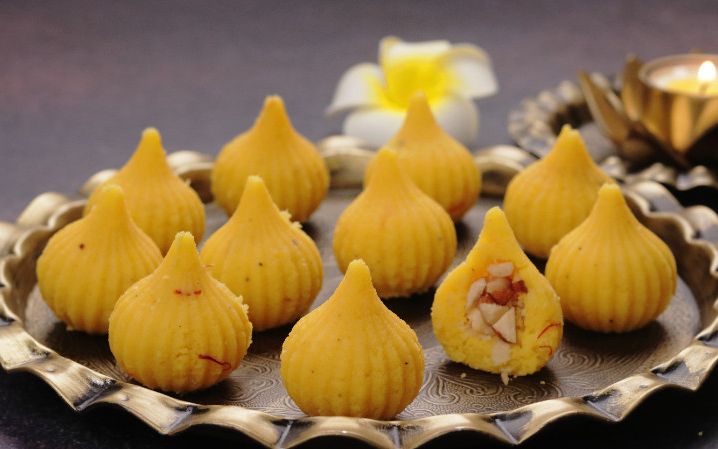
Always cook on the lowest possible flame — khoya scorches on medium or high heat within minutes, producing a burnt, bitter flavor that can't be fixed after the fact. Stir continuously and without stopping; even a 30-second pause while the pan is on heat can produce a stuck, browned patch on the bottom. Shape the mixture when it's at just warm, not hot or fully cold — hot mixture deforms in the mould from its own softness, and cold mixture cracks along the edges when pressed. Set the shaped modak in the refrigerator for 20–30 minutes before serving or packing; this firms the surface and produces a cleaner, more presentable finish for a prasad plate or gift box.
Storing, Gifting, and Shelf Life
At room temperature in an airtight container, mawa modak keeps for 1–2 days — khoya is a concentrated dairy product and spoils more quickly than dry sweets when left unrefrigerated. Refrigerated in an airtight container, it keeps well for 4–5 days; the texture firms up considerably in the cold, so allow 10 minutes at room temperature before serving. For longer storage, mawa modak freezes for up to 2 weeks — thaw at room temperature for 30–45 minutes before serving, and the texture returns to close to its original consistency.
For gifting, individual cellophane or tissue wrapping inside a small box works well — the dense texture holds up during transport without crumbling in the way that ukadiche modak would. Browse more vegetarian recipes for the full festival spread for additional ideas alongside the modak and ladoo for the prasad table.
FAQ
What is mawa modak?
Mawa modak is a festival sweet made from khoya (mawa, or concentrated milk solids), powdered sugar, and cardamom, shaped into the traditional modak form using a mould or by hand. Unlike ukadiche modak, it requires no steaming and no rice flour dough, making it one of the easier Ganesh Chaturthi sweets to prepare at home.
Can mawa modak be made with milk powder instead of khoya?
Yes — full-fat milk powder combined with ghee and a small amount of warm milk or water produces a khoya substitute that works well in this recipe. The texture is slightly grainier and less rich than real khoya, but the result is a reliable, flavored modak that shapes well and holds its form.
How long does mawa modak last?
At room temperature in an airtight container, mawa modak keeps for 1–2 days since khoya is a dairy product that spoils relatively quickly without refrigeration. Refrigerated, it keeps for 4–5 days. The texture firms up considerably in the refrigerator — let it rest at room temperature for 10 minutes before serving.
Can mawa modak be made without a mould?
Yes — roll the cooled mawa mixture into a smooth ball, pinch a peak at the top to create the modak silhouette, and press gentle ridges along the sides with a toothpick to suggest the traditional pleated shape. The result is less uniform than a mould but works well for home prasad distribution.
Why is my mawa modak too soft to shape?
The mixture hasn't cooked long enough to drive off sufficient moisture from the khoya. Return it to a low-heat pan and stir for 2–3 more minutes until it feels drier and pulls away from the sides of the pan. Cool again before attempting to shape — the mixture firms considerably as it cools.
The khoya method and the milk powder shortcut both produce a mawa modak recipe result worth serving as Ganpati prasad, but the flavor difference between fresh khoya and milk powder is noticeable enough to make sourcing fresh khoya worthwhile if a mithai shop is nearby. Once the mixture is at the right temperature, shaping a full tray takes about 3 minutes — the entire recipe from pan on to refrigerator off takes under 40 minutes including cooling time, which is exactly why it fits into the evening-before preparation slot in any festival cooking schedule.