Boondi Ladoo Recipe: The Two Steps Nobody Explains Well Enough
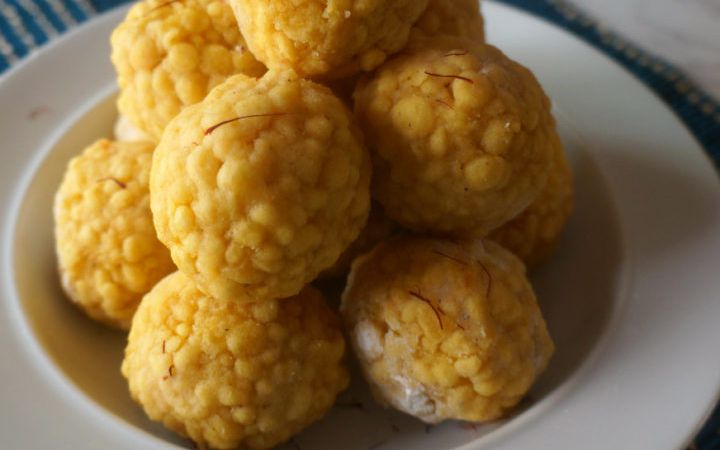
This boondi ladoo recipe covers the batter, the frying, the sugar syrup consistency, and the pressing technique — everything the first attempt usually misses.
Prep time
15 minutes
Cook time
30 minutes (frying + syrup)
Cuisine
Indian (North Indian / Rajasthani / Pan-Indian Festival)
Ingredients
Nutrition
The boondi ladoo recipe has more moving parts than besan or coconut ladoo — a batter, a frying stage, a sugar syrup cooked to a specific consistency, and a narrow window for pressing everything into shape before the syrup sets. Most failed batches don't happen at random; they happen at exactly two moments: the batter consistency check before a single drop goes into the oil, and the sugar syrup thread test before the boondi goes in. This guide is built around those two moments — covering what the right batter looks and behaves like, what the one-string syrup looks and feels like, and what to do when each step goes slightly wrong. For the complete festival sweet planning list, see the Ganesh Chaturthi recipes guide.
What Is Boondi and Why It Matters for the Ladoo
Boondi are tiny, round, deep-fried chickpea flour droplets — the same base ingredient as besan, passed through a perforated ladle into hot oil to create small, uniform spheres. The texture of those spheres determines everything about the finished ladoo: soft boondi that was pulled from the oil while still slightly pale and just set absorbs sugar syrup properly and compresses into a cohesive ball; crispy boondi that stayed in the oil too long stays firm and rigid in the syrup and produces a ladoo that feels like compressed gravel. The boondi ladoo recipe requires the soft version — fried until just set, not until crunchy — which is a different endpoint than the boondi used in raita or chaat. If previous batches produced a hard, crunchy-textured ladoo, the frying stage is almost certainly where it went wrong.
Boondi Ladoo Recipe with Besan — The Batter First
The batter is the variable that determines whether the boondi comes out as round spheres or as irregular, flat, amoeba-shaped blobs. This boondi ladoo recipe with besan starts with 1 cup (100g) of fine gram flour (chickpea flour/besan), passed through a fine sieve to remove any lumps before adding water.
Getting the Batter Consistency Right
Add water gradually — about ¾ cup (180ml) total — whisking after each addition, until the batter reaches a thin, smooth, pourable consistency. The correct consistency is thinner than a pakora batter and slightly thicker than water. The standard test: dip a finger into the batter and hold it over the bowl — the drops that fall should leave the finger as distinct, separate spheres rather than a continuous stream. If the drops fall in a stream, the batter is too thin; add 1 tablespoon of besan and whisk. If they fall as a thick, slow blob rather than a droplet, the batter is too thick; add 1 tablespoon of water. This single test, done before a single drop of boondi hits the oil, prevents the most common failure mode in any homemade boondi ladoo recipe.
Straining the Batter
After mixing to the correct consistency, strain the batter through a fine-mesh sieve into a clean bowl. Any unblended lumps of besan that pass through the boondi ladle holes produce boondi with uneven interiors that don't absorb sugar syrup uniformly — the strained batter produces a more consistent result worth the extra 2 minutes this step takes. According to USDA FoodData Central, chickpea flour is a high-protein, high-fiber ingredient — the same nutritional profile that makes it valuable in everyday cooking makes it a more nutritionally substantive base for festive mithai than refined flour alternatives.
Easy Boondi Ladoo Recipe — Frying the Boondi
Heat enough oil for deep frying in a wide pan — at least 3–4cm (1.5 inches) of oil depth — to approximately 160–170°C (320–340°F). Test the temperature by dropping a tiny amount of batter from a fingertip: it should sink slightly, then rise within 2 seconds and sizzle steadily without immediately browning. This is the correct medium heat for soft ladoo boondi.
Oil Temperature for Soft Boondi
The oil temperature is more critical for boondi than for most deep-fried preparations because the window between underdone (raw inside, sticky) and overdone (crispy, won't absorb syrup) is narrower than for larger items. Too hot — above 180°C (355°F) — and the boondi browns within 30 seconds before the interior has set properly. Too cool — below 150°C (300°F) — and the boondi absorbs excess oil, producing greasy, heavy ladoos.
Using a Boondi Ladle vs. Improvising
A boondi ladle with holes of approximately 3–4mm produces the most uniform spheres. Hold it directly above the oil surface — not 30cm above it — and pour 2–3 tablespoons of batter through the holes at a time, using a second spoon to scrape across the top of the ladle if batter pools rather than flowing. A fine-mesh colander or a slotted spoon held close to the oil works as an improvised tool and produces slightly less uniform boondi but functional results.
Soft vs. Crispy — The Frying Time Difference
Soft boondi for easy boondi ladoo recipe use comes out of the oil after 45–60 seconds per batch — the droplets look set and faintly golden but not browned, and they feel slightly yielding when pressed between two fingers rather than crispy. Remove with a slotted spoon, drain briefly on paper, and keep in a warm bowl covered with a cloth while the sugar syrup is being prepared.
The Sugar Syrup — The Make-or-Break Variable
The sugar syrup for a soft boondi ladoo recipe uses 1 cup (200g) of sugar and ½ cup (120ml) of water, brought to a boil in a heavy pan, then cooked without stirring until it reaches one-string consistency. This is the step that produces the widest range of outcomes depending on how accurately it's judged — and it's the step most recipes describe in 10 words or fewer.
One-String Consistency Explained
To test for one-string consistency: remove the pan from heat, dip a clean, dry finger into the syrup, press it against the thumb immediately, then slowly pull the two fingers apart. At the correct stage — one-string — a single thread forms between the fingertip and thumb and holds its connection for about 1 second before breaking. Under-cooked syrup produces no thread at all; the two fingers pull apart with a sticky smear. Over-cooked syrup produces two or more threads simultaneously, indicating higher sugar concentration that will crystallize and produce a rock-hard ladoo. The one-string window lasts about 2–3 minutes at a steady medium simmer — once reached, remove from heat immediately.
Adding Spices to the Syrup
Cardamom powder (1 teaspoon), a pinch of saffron soaked in 1 tablespoon of warm water, and 4–5 small whole cardamom pods all go into the syrup rather than the batter — adding them to the syrup distributes the flavor evenly through every boondi as it absorbs, rather than concentrating spice in the few boondi that happen to contain it in the batter.
Timing the Combination
Pour the warm boondi into the hot one-string syrup immediately after removing the syrup from heat. Both need to be warm — hot syrup poured over cold boondi doesn't absorb properly and produces a ladoo that crumbles rather than holding together. If the boondi have cooled while waiting for the syrup, microwave them for 20 seconds before combining. Stir the mixture thoroughly so every boondi is coated and allow to rest for 2–3 minutes for the syrup to absorb before pressing.
How to Make Boondi Ladoo at Home — Pressing the Ladoos
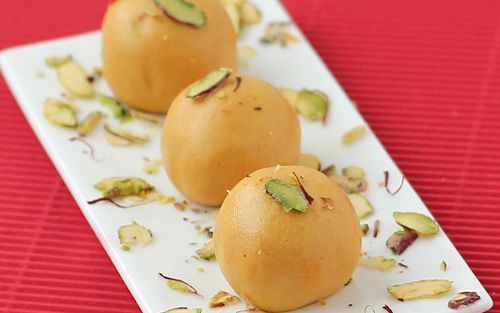
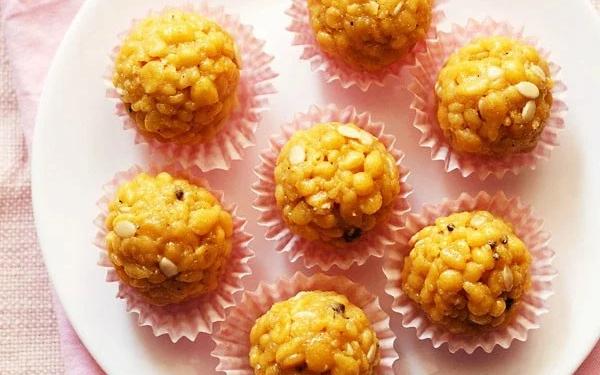
The pressing window opens approximately 3 minutes after combining the boondi and syrup and stays open for about 10–12 minutes before the syrup begins to set. Take a handful of the syrup-soaked boondi (about 40–50g per ladoo), press firmly with both oiled palms in a circular compression motion, and the boondi laddu recipe mixture will come together into a ball. Don't roll it the way coconut or besan ladoo gets rolled — press and compress from all directions simultaneously, rotating the ball in the palms.
Pressing While Warm
The syrup that soaks into the boondi is still fluid enough to act as a binder during this 10–12 minute window. After it sets, the boondi locks into position and further compression breaks the individual boondi rather than bonding them together. Work steadily and don't start pressing until all the boondi has been combined with the syrup — starting too early means the last few ladoos get pressed from a mixture that's cooler and drier than the first ones.
Rescuing a Batch That's Hardened Too Fast
If the mixture firms up before all the ladoos are pressed, place the bowl in a microwave for 15 seconds, stir gently, and continue pressing. Alternatively, cover the bowl with a warm, damp cloth for 2 minutes — the steam softens the surface of each boondi enough to resume pressing without dissolving the syrup entirely.
Traditional Boondi Ladoo Recipe — Regional Styles
The traditional boondi ladoo recipe varies meaningfully by region. Rajasthani motichoor ladoo uses an extremely fine boondi passed through a ladle with 1–2mm holes, producing a paste-like texture after syrup absorption that differs fundamentally from standard boondi ladoo's textured bite. North Indian temple-style boondi ladoo uses coarser boondi, more cardamom, and sometimes a few whole cloves in the syrup for a more aromatic result. South Indian versions — particularly Andhra and Tamil Nadu boondi ladoo — sometimes incorporate roasted cashews, raisins, and edible camphor (pacha karpooram) into the syrup before combining, producing a more complex, layered flavor alongside the standard cardamom.
Sugar Syrup Consistencies and Their Effect on Boondi Ladoo
Sugar syrup consistency is the variable in any boondi ladoo recipe for Ganesh Chaturthi that produces the widest range of outcomes — understanding what each stage produces makes the thread test feel less like guesswork.
| Syrup Stage | Thread Test Result | Ladoo Outcome | Fix |
|---|---|---|---|
| Under-cooked (no thread) | No thread forms | Sticky, won't hold shape | Cook syrup 2–3 more minutes |
| One-string (correct) | Single thread, holds briefly | Soft, holds shape, good texture | This is the target |
| Two-string (over-cooked) | Two threads, stiff | Hard, crystallized ladoo | Add 1 tbsp water, re-cook |
| Over-cooked (caramelized) | Brittle, snaps | Rock-hard, bitter | Cannot be rescued |
Tips for the Best Soft Boondi Ladoo Recipe
Sieve the besan before making the batter — even fine-ground gram flour contains micro-lumps that produce irregular boondi if left in. Work in small batches of 2–3 tablespoons of batter per frying round for the most consistent drop size and the most even oil temperature maintenance. Keep the oil at a steady medium heat throughout — a pan that overheats by the third or fourth batch produces darker, less absorbent boondi. Press ladoos with lightly oiled palms exclusively — dry palms stick to the syrup-coated boondi and pull the structure apart rather than compressing it. The coconut ladoo recipe is the most beginner-friendly alternative if this is the first attempt at a festival ladoo — the technique gap between the two recipes is significant, and building confidence with coconut ladoo first makes the boondi ladoo process considerably less daunting.
Storage and How Long Boondi Ladoo Keeps
A properly made boondi ladoo recipe — with the syrup cooked to exactly one-string consistency — produces a ladoo that keeps at room temperature in an airtight container for 1–2 weeks. Refrigerated, it keeps for 3–4 weeks. The sugar syrup acts as a natural preservative by binding available moisture within the structure of each boondi, leaving very little free water for microbial growth. An under-cooked-syrup ladoo spoils faster since excess moisture remains in the structure. Boondi ladoo freezes well for up to 4 weeks and thaws at room temperature in about 30 minutes without structural damage. Browse more vegetarian recipes for the full festival spread for additional festive mithai ideas alongside the ladoo series.
FAQ
What is boondi ladoo made of?
Boondi ladoo is made from tiny deep-fried chickpea flour droplets (boondi) soaked in a one-string sugar syrup, then pressed into balls while warm. The batter is made from besan (gram flour) and water. Cardamom, saffron, and sometimes small whole cardamom pods or dry fruits are added to the sugar syrup for flavoring.
Why is my boondi ladoo not holding together?
The most common cause is sugar syrup that wasn't cooked to one-string consistency — under-cooked syrup doesn't set firmly enough to bind the boondi as it cools. The second cause is cold boondi being added to hot syrup, which prevents proper absorption. Both the boondi and the syrup need to be warm when combined.
How do you get boondi round and not flat?
Round boondi comes from a batter that's thin enough to drip through the ladle holes as spherical drops rather than a continuous stream, combined with oil at the correct temperature (160–170°C/320–340°F). A batter that's too thick produces flat, irregular shapes; too thin and the drops spread on contact with the oil.
How long does boondi ladoo last?
A properly made boondi ladoo with correctly cooked sugar syrup keeps at room temperature for 1–2 weeks in an airtight container, and up to 3–4 weeks refrigerated. The sugar syrup acts as a natural preservative — under-cooked syrup reduces shelf life since excess moisture remains in the ladoo.
Is boondi ladoo the same as motichoor ladoo?
No — both are made from fried chickpea flour boondi, but motichoor ladoo uses an extremely fine boondi (almost paste-like) passed through a very fine-hole ladle, producing a smoother, softer, more delicate texture. Standard boondi ladoo uses coarser boondi with more textural bite. Both use sugar syrup as the binding agent.
The boondi ladoo recipe rewards patience at exactly two moments — the batter drip test before the first batch hits the oil, and the syrup thread test before the boondi goes in. Every step between those two points follows logically once both variables are right. The first attempt teaches the feel of the syrup thread and the look of the batter drip; the second attempt is almost always noticeably better. The besan ladoo recipe uses the same chickpea flour base in a completely different preparation that's worth making alongside this one on the same festival day.
Tags